Showing posts with label Nancy Young. Show all posts

Wednesday, July 1, 2015

Designing interfaces from the outside in

User interfaces are a pet peeve of mine.

I’m one of those people whose VCR always blinked 12:00. Not because I couldn’t figure it out but because I resented that I had to.

Basically, I have neither the time nor the inclination to read manuals. If I’m paying good money for a consumer-facing product then it better not require an engineering degree to use it.

Not surprisingly, then, I think UI design is every bit as important as product; maybe even more so. Because if your user experience sucks, make no mistake; I will be walking and talking to your competitors.

It wasn’t until I entered the glamorous world of software development that I came to the following conclusion: Interfaces are complicated because development tools require an engineer (or similarly brilliant individual) to use them.

Of course this is a sweeping statement and I’ll gladly debate it but the point is this: Someone with unique skills and knowledge about user-centric design should be creating interfaces. Not someone who knows the product from the inside out.

I know in a traditional model this can create a lot of churn but companies like Crank Software have come up with a way to decouple the roles of embedded engineer and UI designer, allowing them to work in parallel while focusing on their individual core competencies.

I spoke to several members of the QNX concept development team when they were heavily embroiled in creating the latest technology concept car. It was obvious when talking to the engineers and the UI designers that Crank’s Storyboard made both jobs that much easier and the process a whole lot quicker. The end result, achieved in a very short time frame, speaks for itself.


This is great news for people like me who curse like sailors whenever using a remote, microwave, GPS, treadmill, camera, and so on. Indeed, I'm counting on teams like QNX and Crank to ensure the digital car is an enjoyable and intuitive  experience. If not, I do know who I'm gonna call.

It pays to uncover... the new QNX reference vehicle

As you know, we are gearing up for Telematics Detroit next week and bringing our brand new reference vehicle to the show. I would tell you what kind of car it is, but that would take away all the fun! We posted some pictures earlier but we wanted to give you a few more to see if you can correctly guess the brand name and model.

And to make it interesting, if you’re right, we’ll give you a $25 gift certificate to Starbucks! We will award gift cards to the first 25 people who respond with the correct answer and currently reside in the United States or Canada.

Earlier votes don’t count; you have to vote on Twitter, starting today. Simply follow our handle at @QNX_Auto and tweet @QNX_Auto with your guess, and you’ll be entered. And stay tuned on Twitter, where we’ll post more pictures. Don’t have Twitter? You can vote here, but you must include your email. And in order to play fair, QNX employees aren't eligible - shucks.

Check out the pictures below and get your votes in early. The car will be unveiled, and winners notified, on June 6. Good luck!


Sunday, June 28, 2015

HTML5 blooper reel

I find bloopers infinitely amusing — mind you I’m talking about those that come on a reel, not those that happen for real. Missed deadlines, cost over-runs, IP disputes — these are the bloopers we all could do without.

Helping customers avoid bloopers is what we do — so to speak. Except it seems, when we put them in front of the camera. <grin>

Seriously though, no customers were hurt in the making of this video.


This compilation of bloopers from the HTML5 series highlights the professionalism of QNX customers, partners, and employees as well as their good nature.
 

Saturday, June 27, 2015

AUTOMOBILE HTML5 and the software engineer

HTML5 appears to have a number of benefits for consumers and car manufacturers. But what is often good for the goose is not necessarily good for the developer. Talking to the guys in the trenches is critical to understanding the true viability of HTML5.

Andy Gryc and Sheridan Ethier, manager of the automotive development team at QNX, pair up for a technical discussion on HTML5. They explore whether this new technology can support rich user interfaces, how HTML5 apps can be blended with apps written in OpenGL, and if interprocess communication can be implemented between native and web-based applications.

So without further ado, here’s the latest in the educational series of HTML5 videos from QNX.


This interview of Sheridan Ethier is the third in a series from QNX on HTML5.

Enabling the next generation of cool

Capturing QNX presence in automotive can’t be done IMHO without a nod to our experience in other markets. Take, for example, the extreme reliability required for the International Space Station and the Space Shuttle. This is the selfsame reliability that automakers rely on when building digital instrument clusters that cannot fail. Same goes for the impressive graphics on the BlackBerry Playbook. As a result, Tier1s and OEMs can now bring consumer-level functionality into the vehicle.

Multicore is another example. The automotive market is just starting to take note while QNX has been enabling multi-processing for more than 25 years.

So I figure that keeping our hand in other industries means we actually have more to offer than other vendors who specialize.

I tried to capture this in a short video. It had to be done overnight so it’s a bit of a throw-away but (of course) I'd like to think it works. :-)


Thursday, June 25, 2015

Goodbye passwords, hello biometrics

Let's face it — passwords suck.

Every day we have to recall all manner of alphanumeric combinations for bank PINs, network log-ons, corporate email, social networking, and e-commerce. According to Microsoft Research, the average user types eight passwords per day.

During a talk at last year's SAE Convergence, Joseph Carra from the US Department of Transportation said, “Passwords have to go” ... a breath of fresh air for those of us who rely heavily on the "forgot password" option. The stage is set, according to Carra, for biometrics to replace passwords in the vehicle.

Using biometrics for driver preferences is nothing new — my favorite example is a car seat that can identify you by the shape of your butt — but using them to replace passwords makes perfect sense.

Ultrasound fingerprinting, iris scans, facial recognition, signature dynamics, voice recognition, keystroke dynamics, hand geometry, skin patterns, and foot dynamics are already being used in enterprise security, law enforcement, border control, ATM transactions, and so on. And second-gen biometrics promise to pump up the Sci-Fi factor with neural wave analysis, electro-physiological biometrics, skin luminescence, body odor, and so on.

Many technologies eventually find their way into the car after becoming popular elsewhere — mobile telephony, media players, GPS navigation, etc. I can’t think of too many world-changing technologies that got their start inside the car. But given the innovative trajectory of today’s auto industry, that may be about to change.

Tuesday, June 23, 2015

Concept car out. Reference vehicle in.

Our big announcement for Telematics Update is that we are not showing a concept car. Odd news, you say. The truth is, we're not building a concept car because we are building a reference vehicle. Splitting hairs? Not really.

Unlike the Corvette and the Porsche, our demo for this show will be based on the exact same technology that our customers are using today to design their next-generation systems.

So why vehicle instead of car? Is it a truck? Nope. A van? Negative. What about a motorcycle? Double negative.

I was hoping to give you a sneak peek at what we are working on but I'm not allowed to give away the details. However, I did manage to get these shots – let me know if you can see the vehicle. :-)


Monday, June 22, 2015

Word of the day: Electrification

At this week’s Convergence in Detroit, Mark Reuss, NA president of GM, told a crowd at Tuesday’s keynote, “Hybridization is no longer enough; electrification is the future.”

What struck me most about this statement was the word, electrification; I had yet to hear it in the automotive context. So I did what anyone with a rocket stick would do, I googled it on my way home. The trail led back to GM’s blue paper on sustainable urban mobility, Roadmap to 2030.

For some time now I’ve been thinking about getting an electric or hybrid car but have been bemoaning the lack of choice. Apparently, the fact that a new ground-transportation paradigm requires wide-spread societal alignment hadn’t occurred to me. You just put up a few recharging stations, right?

GM EN-V electric concept car
Source Wikipedia
GM makes eight recommendations in their blue paper, two of which I find to be particularly interesting:

  • Integrate electrically powered, connected vehicles into a multi-modal transport system that incorporates sophisticated inter-city transport, comprehensive subway systems, traditional vehicle movement, and specialized smaller urban vehicles
     
  • Identify a series of “lighthouse” projects to demonstrate the potential and viability of connected electrically driven vehicles in a controlled environment such as an eco-city or small town

It is nice to see a company taking such a definitive stand and boldly painting a vision for the future; this kind of creative thinking is what we need.

I was surprised to discover the blue paper is from 2010; still if you haven’t already read it, it is worth a look. You can download the paper from the GM web site.

Friday, June 19, 2015

AUTOMOBILE Is HTML5 a good gamble?

As the consumer and automotive worlds continue to collide, HTML5 looks like a good bet. And not a long shot either. In fact, the odds are all automakers will eventually use it. But since the standard won’t be mature for some time yet, should you take a chance on it now? 

To answer this, Andy Gryc talks to Matthew Staikos of RIM. Matthew is the manager of the browser and web platform group at RIM, and has over 10 years of software development experience with a strong focus on WebKit for mobile and embedded systems. Matthew co-founded Torch Mobile, which was acquired by RIM for their browser technology.

Andy’s conversation with Matthew is the subject of the following video, the second in an educational series designed to get an industry-wide perspective on HTML5. 


This interview of Matthew Staikos is the second in a series from QNX on HTML5.

Wednesday, June 17, 2015

AUTOMOBILE Making of the QNX concept car... honest

We created this video as a backdrop for CES 2015 where we unveiled the latest QNX concept car (a Porsche 911). Good thing, too, as people clearly stated that they would not have believed we did this cool retrofit ourselves without proof.


The need for green in automotive

The need for environmentally friendly practices and products has become so painfully obvious in recent years that it’s no longer possible to call it a debate or a controversy. Nowhere is this more conspicuous than in the automotive industry.


Working at QNX has given me insight into just how complex the problem is and how going green in automotive is not going to be a revolution. I've come to realize that it will require a good number of players on a large number of fronts.

An example of what happens when
your car takes way too long to boot. :-)
What we at QNX are doing to move the cause forward is called fast booting. Some operating systems take up to 60 seconds to boot. Can you imagine getting in your car, turning the ignition, and waiting a minute for your radio to work? Me either.

To prevent such undignified delays, these systems typically do not power down completely. Instead, they suspend to RAM while the vehicle is off. This lets the system boot ‘instantly’ whenever the ignition turns over. But because there’s a small current draw to keep RAM alive, this trickle continually drains the battery. This might have minimal consequences today (other than cost to the manufacturer, which is a whole other story) but in the brave new world of electric and hybrid cars, battery capacity equals mileage. Typical systems thus shorten the range of green vehicles and, in the case of hybrids, force drivers to use not-so-green systems more often. More importantly perhaps, these systems give would-be buyers ‘range anxiety’. Indeed, according to the Green Market’s Richard Matthews, battery life is one of the top reasons the current adoption rate is so low.

A little-known feature of QNX technology helps solve this problem.

Architects using the QNX OS can organize the boot process to bring up complex systems in a matter of seconds. Ours is not an all-or-nothing proposition as it is with monolithic operating systems that must load an entire system before anything can run – Windows and Linux are prime examples. QNX supports a gradual phasing in of system functionality to get critical systems up and running while it loads less-essential features in the background. A QNX-based system can start from a cold boot every time. Which means no battery drain while the car is off.

And while this is no giant leap for mankind it is certainly a solid step in the right direction. If the rest of us (consumers, that is) contributed similarly by trading in our clunkers for greener wheels, the industry could undoubtedly move forward in leaps and bounds. I suppose this means I’m going to have to take a long hard look at my 2003 Honda Civic.
 

Tuesday, June 16, 2015

AUTOMOBILE Hanging out with the cool kids at the EcoCAR booth

If you read Jin Xu's post earlier this week, you are already up to speed on the EcoCAR 2 competition established by General Motors and the U.S. Department of Energy. If you didn't read it, here's the skinny: To drive home with first prize, university teams must reduce the environmental impact of a 2015 Chevy Malibu without compromising performance, safety, or consumer acceptability. If that sounds hard, it is. Which explains why, out of 150 university teams that applied to compete, only 15 made the grade.

Today, at SAE Convergence, I was lucky enough to meet two of the talented young people participating in this competition: Ahmed Uddin from Wayne State University and Andrew Palmer from Ohio State University. Ahmed and Andrew had just finished delivering remarks at the EcoCAR booth when they stopped to chat with me about their projects.

The EcoCAR 2 Chevy Malibu
The Wayne State team dub themselves the Hybrid Warriors, and they are modifying the Malibu with a parallel-through-the-road PHEV. In a nutshell, the modified Malibu has two power trains, with an electric motor in back and a 2.4L engine in front. By taking this parallel approach, the team has actually upped performance, even though they replaced the stock engine with a power plant that cranks out less power, takes up less room, and puts out fewer emissions. Before these modifications, the car went from 0 to 60 in 9.5 seconds; now it takes only 8.9 seconds.

Meanwhile, the Ohio State team has opted for a series-parallel PHEV that uses an electric motor for the rear axle and a 1.8 L engine for the front. The systems can operate in charge-depleting, charge-sustaining series, and charge-sustaining parallel modes. Personally, I was fascinated by Andrew Palmer's description of the team's infotainment system (redesigning the center stack is an optional component of the EcoCAR 2 competition) and how they aim to make phone connectivity more seamless.

Cooler yet, the team is working on augmented reality, using a BlackBerry PlayBook. Picture this: You hold a PlayBook over the engine of your car, and the screen overlays a transparent view of the engine. The possibilities for this kind of functionality are enormous, and I invite you to check out two blog posts (here and here) from another Andrew — QNX's Andrew Poliak — for examples of how augmented reality could pimp your next ride.

Before you go, remember to follow @QNX_Auto on Twitter, where I will continue to tweet out reports from SAE Convergence.

Sunday, June 14, 2015

Day four of CES: The home stretch

We all thought that day four would be a lot less busy and it was, however, we still had people waiting for a demo up until the dying minutes of the show.

The day opened with a video shoot by Brian Cooley - one of my favorite interviewers. This man can distill a complex technology down to the basics after a 10 minute briefing. And he can shoot a video in one take. Impressive.


Brian Cooley dropped by to do a spot for CNET. I really admire his ability to distill complicated subjects into very digestible bits.


Dr. Phil once again. Only this time he is in the soundproof booth, ready to wow everyone with a the first-ever HD stereo video call in the car.


Delphi had a beautiful QNX-based system in an Audio A7. Everything was gorgeous, responsive, and flawless.


One of the really cool things about the Delphi system was the theater seating in the back seat. Why watch a movie anywhere else?


Andrew Poliak, director of business development, did booth duty whenever not in meetings.


Day three of CES: Almost too exciting

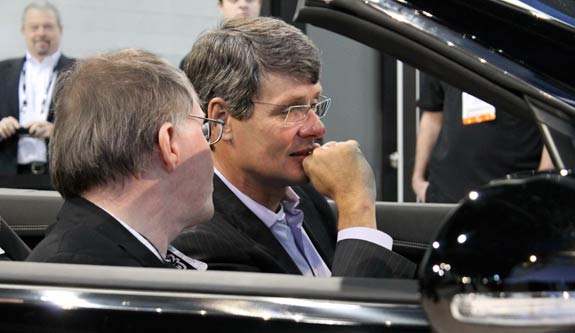
Day three was interesting in that we had too many VIPs to see the Bentley at the same time: Tanner Foust, Thorsten Heins, and high-level execs from both Mercedes and Porsche. All had a good long look and chat inside the Bentley. I won't tell you which ones had to wait. ;-)

Nice problem to have, I know... but a little stressful nonetheless. (You never want to turn people away.) Of course everything worked out just fine. Better than fine, really.

Thorsten was very gracious and took the time to shake hands with all QNX employees. Tanner Foust (whom I did not know before the show) patiently posed for pictures with those QNX employees who were more informed than me about his star status.


Thorsten Heins (RIM CEO) had a good long chat with his buddy, Dan Dodge (QNX CEO).


Race car driver, Tanner Foust, drifted into the booth to see what QNX was all about. Here he is with Justin Moon from the concept development team.


Kerry Johnson, manager of automotive product management, pinch hit between meetings with customers, press, and analysts.


Victor Marques took his job on the show floor as seriously as he does when in the office.

Saturday, June 13, 2015

What’s HTML5 got to do with automotive?

There’s been a lot of noise lately about HTML5. A September 2015 report by binvisions shows that search engines and social media web sites are leading the way toward adoption: Google, Facebook, YouTube, Wikipedia, Twitter, and plenty more have already transitioned to HTML5. Some are taking it even further: Facebook has an HTML5 Resource Center for developers and the Financial Times has a mobile HTML5 version of their website.

It won’t be long before HTML5 is ubiquitous. We think automakers should (and will) use it. 

To elucidate the technology and its relevance, we’ve created a series of educational videos on the topic. Here is the first in that series. Interviews with partners, customers, and industry gurus will soon follow. 


This simple overview is the first in a series from QNX on HTML5. (Personally I like the ending the best.)

Wednesday, June 10, 2015

CES press: This just in!

OK well, maybe not 'just in' but these articles and releases were posted yesterday and are quite exciting if you are following QNX technology:

TeleCommunication Systems Supplies Advanced Navigation for QNX CAR 2 Application Platform

TI Takes The Driver’s Seat With An Unrivaled, Full System Solution For Connected Automotive Infotainment


Day two of CES - QNX, Harman, and Vipers, oh my!

Day two came and went very fast. It felt as frantic as day one. I did manage to leave the north hall though... only to find the center hall to be just as intense. Maybe even more so. It had booths the size of city blocks. Maybe even bigger; certainly louder.

I somehow found Harman International. And I was not disappointed. There were at least four demos sporting QNX technology.

QNX CAR 2 was on display and in full form in the Harman booth. Nice to see the QNX logo so prominently displayed.


Closer look at different display in the same demo system. This 3D map from Elektrobit just never gets old.


Harman again. QNX again. This is almost embarrassing! ;-)


Harman and QNX and Vipers, oh my!


I managed to get permission to poke my head into the car. The digital instrument cluster was gorgeous.


The Viper's infotainment system was just as beautiful. Note to my boyfriend: I do believe this car is currently shipping.


The QNX booth staff, including biz dev manager Emil Dautovic, were hard at work once again. Although how hard can it be to talk to nice people all day? Maybe if there were more chairs...


Of course we knew our latest concept car would be a hit but we weren't exactly expecting the mob scene that it was again on day two.


Joe Cusumano, automotive field applications engineer, in conversation.


Linda Campbell, director of QNX strategic alliances, was her usual tireless self.


Our inimitable automotive field applications engineer Dan Baergen.


And our very own Dr. Phil, mastermind of the QNX acoustics processing and noise cancellation products.

Full-duplex in the car? Who even knows what this means?

I know lots of people don't understand full-duplex. Hell, I think most people have never even heard of it. Unfortunately, these same people have repeatedly experienced its poor cousin — half-duplex — without really understanding either.

Please don't take me wrong. I'm not patronizing. I spent a few years in telecoms and barely understand it myself. What I do know is that half-duplex = bad. And that full-duplex = good.

So when I talked to my colleagues at the office today, I knew we were using half-duplex. How did I know? I started to say something and so did someone else at the other end of the line. I couldn't hear them talking while I was talking (a certain amount of latency adds to the circus) so I stopped talking... and so did they. Then there were lots of simultaneous barely-understood apologies and a long uncomfortable silence. Then we both tried to break the silence at the same time; more uncomfortable silence. Very awkward and distracting. I know you know what I mean.

So... um... could someone please fix this? I mean, we send people to the moon after all.

I hate to blow our own (proverbial) horn (well sometimes) but believe me, I have to. QNX has THE best audio technology solution in or out of the car. And this technology, just so happens to be in the new QNX technology concept car at CES. Yes, really!

Today I witnessed a conversation in the QNX booth between someone in the Bentley and someone in a sound-proof booth. Well, to my (sheer) delight, one person talked while the other person talked over him... and both heard the other! Just like a real face-to-face conversation with overlapping dialogue. It was so natural, it almost slipped by as if it were expected:


In a world where communication is more often than not at the root of all successes and failures, I think this is nothing short of a long-overdue miracle.

QNX CAR 2 — the extended version

The world of video is a ruthless one; just as we posted the QNX CAR demo it was out of date.

But, hold on a minute. As I write this I realize it’s not the video world at all; it’s the software world that creates new technology at breakneck speed. And QNX certainly does its part.

The QNX CAR 2 application platform has come a long way in a matter of months. We needed to update the original video to keep pace with the technology but also to address customer demand for more detailed information.

So this video is a step-by-step demo – definitely not for the tire kicker. But if you really want details on what automakers and tier ones can achieve with QNX CAR technology, hit play.


Tuesday, June 9, 2015

Day one of CES — so far so great!

The QNX booth was like a mob scene. I think Phil Hetherington, senior director of the QNX acoustics group, hit the nail on the head when he said, "it's like a mosh pit in here." (He meant it in a good way. ;-)

I'm so proud and happy for the guys who spent their Christmas vacation working on the car. People are absolutely clamoring over each other to see it. I think there were more pictures taken of the Bentley than of the attractive talents in all other booths combined.

CES is a show like no other. Even as I write this I know I am missing something exciting on the show floor.

So with this in mind, I bid everyone adieu. I'll get some more shots today.


One of three demos in the Elektrobit booth (3220 North), showcasing the QNX CAR application platform.


Another example of what happens when you put two world-class suppliers together — Elektrobit and QNX, of course.


This demo replicates an impressive infotainment unit created for Audi using the QNX CAR application platform and EB street director.


EB street director and QNX CAR application platform — up close and personal.


Such an honor to be recognized again at this year's CES show!


Solowheel was a big hit! It's a gyro-stabilized electric unicycle that can be used as you would an electric bicycle. www.solowheel.com


Shooting our own video was really challenging as it was so hard to get 5 minutes in the Bentley. When we did, we still couldn't keep people away from the car!


Alexandre James, from the QNX concept design team, moved smoothly from software developer to company spokesperson.


Mark Rigley, concept design team lead, looked a lot more refreshed than he did last week when the car was still in a work in progress.


It seemed almost everyone wanted to capture the excitement of the new QNX technology concept car. Here's Andy Gryc, the perennial spokesperson, giving one of many demos throughout the day.


While the Bentley Continental was the bell of the CES ball, the Jeep Wrangler (2015 QNX reference vehicle) still did the job of capturing people's interest.


Sheridan Ethier, the hard-working manager of the QNX CAR engineering team, talked nonstop about the technology that he and his engineering group create.